
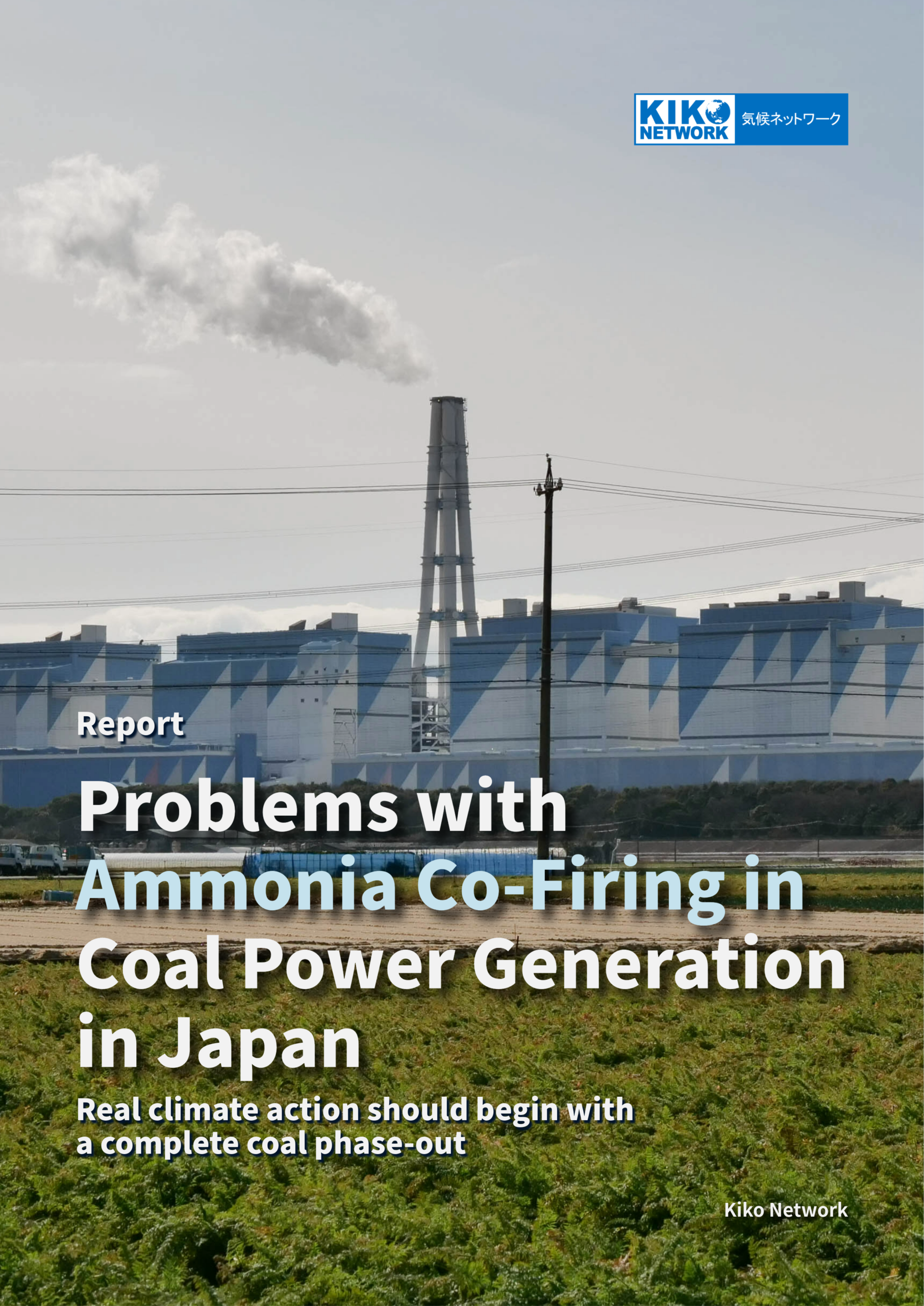
On December 5, 2025, Kiko Network released a report titled "Problems with Ammonia Co-Firing in Coal Power Generation in Japan - Real climate action should begin with a complete coal phase-out. " The Japanese government is promoting ammonia fuel for coal-fired power plants as a pillar of its decarbonization strategy (GX strategy) and providing massive public support through subsidiary like the "Long-Term Decarbonization Power Source Auction." However, upon re-examining the policy, the following serious issues have come to light.
- Negligible emission reduction effect: Considering the entire lifecycle, the CO2 reduction effect at 20% ammonia co-firing is only 12%, and using gray ammonia may actually increase emissions.
- Substantial increase cost and burden on consumers: The maximum support price for ammonia co-firing projects is set significantly higher than for other power sources. These costs are borne by electricity retailers and ultimately recovered through consumer electricity bills.
- Risks of ammonia accidents and leaks: Several ammonia leak accidents have occurred along supply chains in countries such as the United States and Indonesia, raising concerns about inadequate safety measures.
As South Korea is shifting away from coal, Japan's strategy clings to costly, low-impact ammonia co-firing is causing it to be internationally isolated. In this report, Kiko Network proposes shifting away from measures that prolong coal-fired power and moving toward a fundamental policy change that prioritizes renewable energy.