
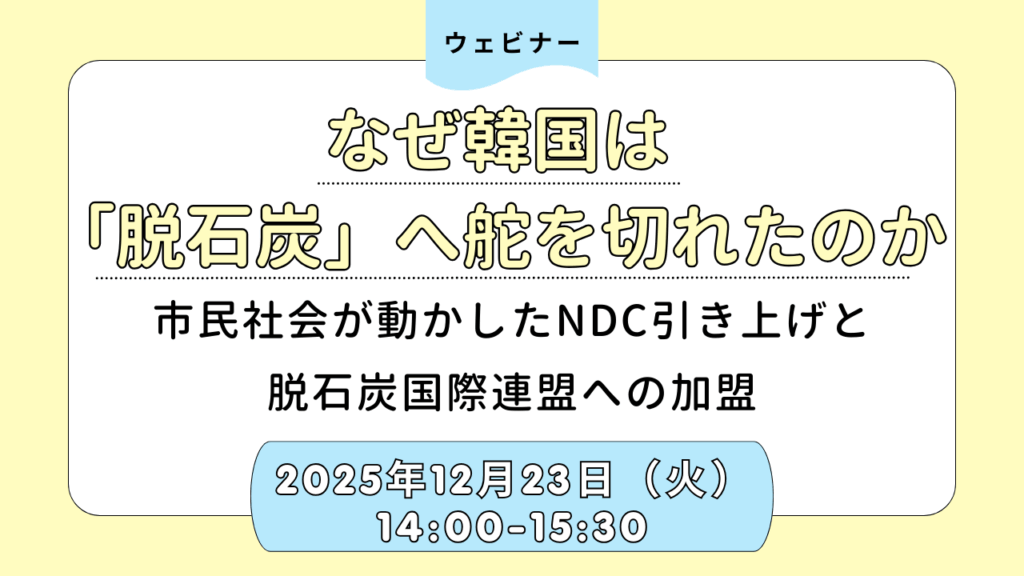
| Title | Behind South Korea's Shift Toward“Coal Phase-Out”? -How Civil Society Pushed the Government to Enhance its NDC and Join the PPCA- |
| Date/Time | December 23, 2025 (Tuesday) 14:00-15:30 |
| Format | Online(Zoom) |
| Fee | Free / for donation |
| Max | 100 |
| Organized by | Kiko Network |
| Note | with simultaneous interpretation |
This webinar was held in December 2025. Please review the materials and video.
Purpose
South Korea, which like Japan had planned to keep using coal-fired power, has seen significant shifts since last year. In August 2024, the South Korea’s constitutional court ruled that the reduction target under the country’s climate change law (Carbon Neutral Framework Act) does not conform with protecting the constitutional rights of future generations. As the amendment to the Government Organization Act passed the plenary session of the National Assembly and immediately became effective in September 2025, the Ministry of Climate, Energy and Environment (MCEE) was newly established in October. During the UN climate conference in Belém, Brazil, COP30, the Korean Cabinet on November 11th decided to set a Nationally Determined Contributions (NDCs) target of reducing greenhouse gas emissions by 53-61% from 2018 levels by 2035, and also officially announced to join the Powering Past Coal Alliance (PPCA) on November 17th, demonstrating to the world a rapid succession of steps toward coal phase-out. The new NDC is more ambitious than the previous target, and the South Korean government is advancing its efforts to strengthen NDC alongside its legalization.
While Japan is strongly promoting ammonia co-firing in coal-fired power plants as part of its decarbonization strategies, South Korea has announced its policy to exclude ammonia co-firing projects from power market auctions and phase them out.
As South Korea starts to move toward a definitive phase-out of coal-fired power, how did civil society encourage the government's decision? We will hear from the field on the latest developments in the country's coal phase-out policy, covering the process of its NDC enhancement and its decision to join the PPCA.
Program
1.2035 NDC : Success or Failure? 1 Year after the Constitutional Court Decision (PDF)
Sejong Youn( Plan1.5, Policy activist/Attorney)
2.Korea’s Pathway Toward Coal Phase-out (PDF)
Saehee Jeong (SFOC, Head of Diplomacy)
3.Q&A
Why Can't Japan Move toward “Coal Phase-Out”? (PDF)
Moderator Mie Asaoka (Kiko Network, President/Attorney at law)
Presenters' Profiles
Sejong Youn, Policy activist / Attorney
Sejong practiced law in the field of environmental regulation and international dispute since 2012. In 2019, he joined the civil society to fight climate crisis and has worked on various issues including coal phase-out, fossil fuel finance, carbon pricing, and energy transition policy. Sejong is the counsel for the Korean Youth Climate Litigation where the Korean Constitutional Court found the climate law unconstitutional for failing to protect the fundamental rights of the youth plaintiffs. https://www.plan15.org/team_eng
Saehee Jeong, Head of Diplomacy at Solutions for Our Climate (SFOC)
Saehee Jeong is responsible for communicating domestic climate and energy policies to international partner organizations and analyzing international climate policy trends. She is an active member of Think20 (T20), an engagement group of G20 and is working to create various cooperation opportunities for the clean energy transition in India and South Korea. https://forourclimate.org/people/50